A Raleigh Restaurant Nobody Was Searching For, and the 928K Impressions That Found It
A Raleigh sushi restaurant that ranked nowhere on Google now shows 928K+ organic impressions and average position 7.8 over the latest 16-month Search Console window. Here is the search work behind that climb, and why a local organic impression is high-intent demand, not a vanity number.
Type "sushi Raleigh" into Google at the start of the engagement and one of the better rooms in the city did not come up. Not on page one. Not on page two. The food was there. The demand was there. The search result was not.
The build started from that gap. Search Console for the property now shows more than 928K organic impressions across the latest 16-month window, with search demand that was invisible at the start.
This is not an AI story. It is a search story. Here is how it happened.
What the Business Actually Had
Sushi One is a Japanese restaurant in Raleigh, run through THEVHOUSE. The kitchen was strong. The dining room filled up on the nights people already knew about it. Everything past those three words, already knew, was the problem.
There was no keyword strategy. No optimized pages. A Google Business Profile that sat mostly untouched. In a market where a hungry person three miles away picks a restaurant by typing four words into a phone, the business was invisible at the exact moment the decision got made.
That is the quiet cost of no search presence. It does not show up as a bad review or an empty table you can point to. It shows up as the customer who never knew you existed.
The Work, Not the Magic
Search growth is unglamorous. It is a hundred small, correct decisions repeated until Google agrees with you.
The first move was demand mapping. Google Search Console showed what people near NC State and downtown Raleigh were already typing: "sushi near me," "Japanese restaurant Raleigh," "best sushi Raleigh." Those queries became the skeleton of the site. Pages got built to answer them directly instead of hoping a generic homepage would rank for everything.
The second move was on-page structure. Titles, meta descriptions, headings, and schema were written for humans first and readable by crawlers second. Each page targeted one intent instead of many.
The third move was the Google Business Profile. Categories, hours, photos, and menu detail got completed and kept current. Local citations, the same name, address, and phone number across every directory, were made consistent so Google could trust the listing.
Then position tracking turned it into a loop. Search Console got exported on a monthly cadence. Pages gaining ground got reinforced. Pages stalling got rewritten. Nothing was set and forgotten.
One process ran quietly in the background: a review-response workflow that cut the owner's reply time by roughly 85%, which kept the Business Profile active and signaling to Google without adding to anyone's day.
The Thread Nobody Names
Here is the part most restaurant marketing misses.
An organic impression for a local restaurant is not a vanity number. When someone types "sushi Raleigh" on a Tuesday night, they are not browsing for fun. They are often hours, sometimes minutes, from a purchase decision. Every impression is a person standing at that decision with high intent.
That is the invisible thread. Search visibility is where local demand shows up first. Closing the gap between that demand and a findable listing is not a slogan; it is meeting people who were already looking and had nowhere accurate to land.
What Search Console Shows Now
The numbers keep moving after the foundation work. A full Performance export dated 2026-08-07 (Web results, Last 16 months) is the locked source for the figures below.
Average organic position moved from an 18.5 baseline at the start of the engagement to a 7.8 impression-weighted average across that 16-month window: clear of page two and well inside page one, where click-through rates start to compound.
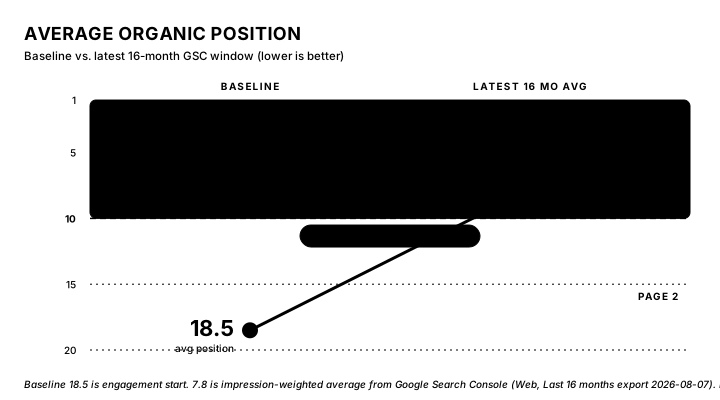
In the same window, Google Search Console recorded 928,756 organic impressions and 12,260 organic clicks.
These figures are organic Search Console results. Paid channels are not counted here. The work was treating search as infrastructure: build the pages demand is already asking for, keep the profile honest and current, measure, and reinforce what works.
If You Run a Local Business
Open Google right now and search the way your customer would, the words they would actually type, not your business name. If you are not on page one for that search, that is not a small gap. That is every hungry person within a few miles choosing someone else while your kitchen sits ready. Start there. Fix that one search.
Jason H. Vo
Marketing Analytics & Workflow Automation