The Rule I Added to Every n8n Workflow After a Structural Audit Found Gaps I Missed
When automation systems work, you stop interrogating them. Here is what a formal gap analysis of an n8n workflow stack uncovered, and the three-layer compliance gate built to close those gaps.
The workflows looked clean.
Nodes connected. Data flowed. Agents fired in the right order. From the canvas, the system looked like it was working.
Then a structured audit of the whole stack turned up gaps the canvas never showed.
Not errors. Gaps. The kind that only show up when you stop asking "does it run?" and start asking "what happens when it does the wrong thing?"
What Was Being Built
A multi-agent automation system in n8n. Several workflows chained together: discovery, enrichment, routing into downstream agents. Nodes everywhere. Some called external APIs. Some parsed and reshaped data.
The system worked. That was the problem. When something works, trust creeps in. And when trust creeps in, interrogation stops.
The Audit
The pass was formal, not a glance. Every assumption about the stack got treated as a hypothesis and stress-tested.
Several gaps surfaced.
The one that reframed everything: no node had a documented contract for what it was allowed to do to data. Nodes were writing, transforming, routing, with no enforcement layer. A misconfigured Email node could push data it should never touch. An Agent node could fire without the 3 fields required to run correctly. Nothing at the workflow level would catch it. The canvas would still show green.
A related gap: no pre-flight check existed. The system assumed health. It never verified it.
The Governance Layer
The response was not to add more logic. More logic would have made the system harder to read and easier to break in a new way.
The response was to add a compliance gate. Three layers, each one wrapping the system at a different depth.
Layer 1: Rules. Two rules, written as law before any workflow modification proceeds:
- REG-001: No node may perform deletion operations. Ever. Data out is write-only or transform-only. If you need to remove data, that is a separate, documented, human-reviewed process.
- REG-002: Every Agent node must carry exactly 3 fields: system prompt, input variable, output format. If any of the 3 are missing, the workflow does not run.
Layer 2: Manifest. node_fix_manifest.json is a per-node SSOT that documents what each node is allowed to do and runs a check against those contracts before execution. The preflight script, preflight_manifest_check.js, runs every time a workflow is modified or before execution in high-stakes contexts. That script closed the pre-flight gap.
Here is what a manifest entry looks like in practice:
json
{
  "_meta": {
    "version": "1.0.0",
    "description": "SSOT for expected n8n node parameter states."
  },
  "workflowId": "<workflow-id>",
  "nodeId": "<node-uuid>",
  "name": "Prepare Email Data",
  "type": "n8n-nodes-base.set",
  "regressionRisk": "high",
  "lastVerified": "2026-05-26",
  "checks": [
    {
      "type": "set_assignment_value",
      "assignmentId": "assign-from",
      "description": "from fallback must end with || '(system)' not || ''",
      "expected": "={{ $json.headers?.from || $json.from || '(system)' }}"
    },
    {
      "type": "set_assignment_value",
      "assignmentId": "assign-subject",
      "description": "Subject fallback must include (no subject) guard",
      "expected": "={{ $json.headers?.subject || $json.subject || '(no subject)' }}"
    }
  ]
}
And the preflight check that validates it:
js
function checkSetAssignmentValue(node, check) {
  const assignments = node.parameters?.assignments?.assignments || [];
  const item = assignments.find(a => a.id === check.assignmentId);

  if (!item) {
    return { pass: false, reason: `Assignment id="${check.assignmentId}" not found` };
  }
  if (item.value !== check.expected) {
    return {
      pass: false,
      reason: `Assignment "${check.assignmentId}" drift`,
      actual: item.value,
      expected: check.expected
    };
  }
  return { pass: true };
}
The check fetches the live node state from the n8n API, runs every registered check against it, and exits 1 if any drift is detected. Nothing manual. Nothing assumed.
Layer 3: Drift Detection. A lightweight process that checks hourly whether node parameters have shifted from their defined state. Automation systems drift. Nodes get edited. Connections get tweaked. The drift detector treats that as a risk signal, not a normal event.
The gate has been live since June 2026. It has not needed to fire dramatically. That is the point. A gate that rarely trips is not a failed gate; it is the floor you stand on.
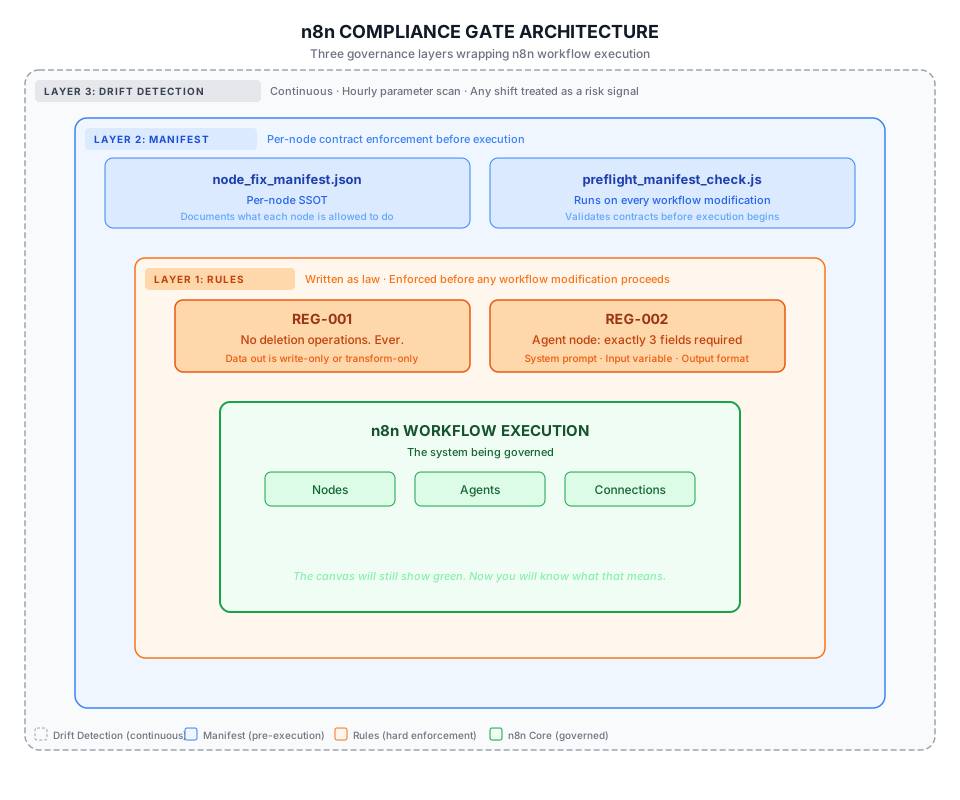
Three layers. Each one wraps and governs what sits inside it.
One Thing to Check
If you run n8n workflows and you have not defined what your nodes are allowed to do to data, not what they do but what they are permitted to do: you have a gap.
Start with REG-001. Define the rule. Write it down. Make it a gate.
The canvas will still show green. Now you will know what that means.
Jason H. Vo
Marketing Analytics & Workflow Automation